The Critical Juncture of Childbirth: Periodic Turbulence in the Employment Trajectories of Mothers in Europe
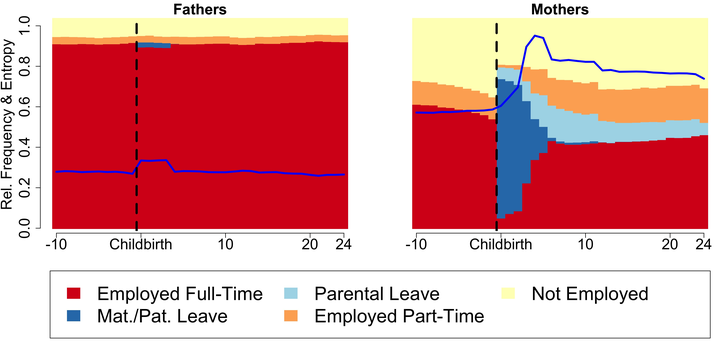 Image credit: Reichert, Emery & Bartova
Abstract
The employment trajectories of mothers around childbirth differ within and between European countries, with implications for long-term attachment to the labour market. Existing research has focused mainly on comparing employment status before and after birth, paying less attention to the intervening process. This paper describes how this critical juncture in employment trajectories plays out in the first 24 months after a child is born in 20 European countries. Using microlevel data for 3,538 couples from the EU-SILC, we identify nine typical patterns of employment trajectories of mothers around childbirth, covering a period of 10 months prior to birth until 24 months after. Although five of these patterns are stable, the remaining four reveal substantial periodic turbulence. The turbulent trajectories affect about 33% of all mothers within our sample. We also find a considerable educational gradient for membership in each pattern. Higher educated mothers are twice as likely as lower educated mothers to experience a turbulent post-birth period of employment that results in part-time employment. Lower educated mothers are more likely to exhibit periodic turbulence reflecting intermittent employment. On the country level, we find large differences in how heterogeneous employment patterns are within countries. Additionally, we find a distinct set of clusters that represent long and stable leave usage in some specific Central & Eastern European countries.

Tom Emery
Associate Professor
My research interests include family sociology, demography and improving the empirical base of social science research generally.