 Image credit: Soler, Emery & Kanas, Sociological Science (CC BY)
Abstract
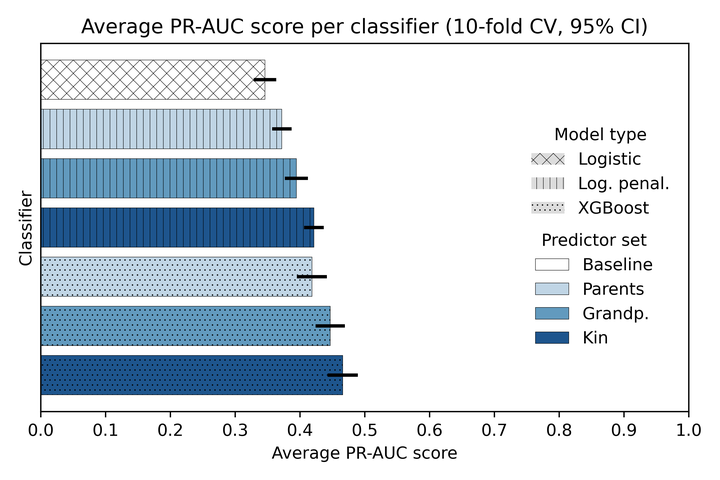
How first-time parents arrange childcare has critical implications for their careers and the child’s development. Previous research shows that childcare choices are shaped by family care availability, understood as an additive function of a small set of parental and grandparental characteristics. However, research on family networks suggests that care availability is rather a non-linear, non-additive function of large family networks. We compare the predictive ability of these two perspectives using a machine learning framework and register-based family network data. We find that considering how the child’s great-grandparents, aunts, uncles, and cousins shape care availability, and modeling their influence using more flexible models, provides small yet significant improvements in predictive ability, particularly among more disadvantaged parents. Predictions are driven by parents’ and grandparents’ socioeconomic characteristics, but cousins’ age and daycare use are important yet understudied predictors. Other important understudied predictors include parents’ self-employment, healthcare spending, and timing of daycare uptake.

Tom Emery
Associate Professor
My research interests include family sociology, demography and improving the empirical base of social science research generally.