Mapping spatial colleague connectivity patterns from individual-level registry data to inform regional pandemic interventions
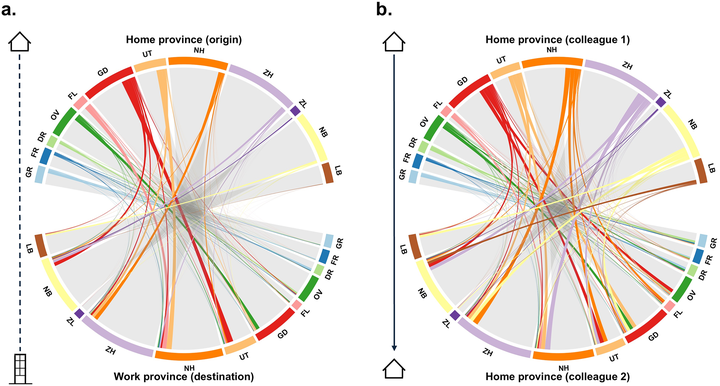 Image credit: Song et al., PLOS Computational Biology (CC BY)
Abstract
Human mobility and social contact patterns are key drivers of infectious disease transmission, yet quantifying geographical connectivity at a fine spatial scale remains a challenge. We quantified geographical connectivity through the workplace using employment registry data covering more than 8 million workers in the Netherlands, producing colleague-connectedness metrics indexed by municipality triplets (two residential municipalities and one workplace municipality). Using the spread of SARS-CoV-2 Omicron as a test case, we found that a two-fold increase in within-province colleague connections was associated with a 3.7-day earlier onset, and between-province connectivity with a 2.5-day earlier onset. Regional lockdown scenarios showed heterogeneous impacts: locking down Zeeland would remove 2.6% of national colleague links, whereas Amsterdam alone would remove 10.0%. These fine-grained spatial connectivity data can serve as spatial mixing matrices in future transmission models, enabling more regionally targeted pandemic policy.

Tom Emery
Associate Professor
My research interests include family sociology, demography and improving the empirical base of social science research generally.