Families, Households, Networks: Rethinking the Relational Structure of Families Through Large-Scale Network Data
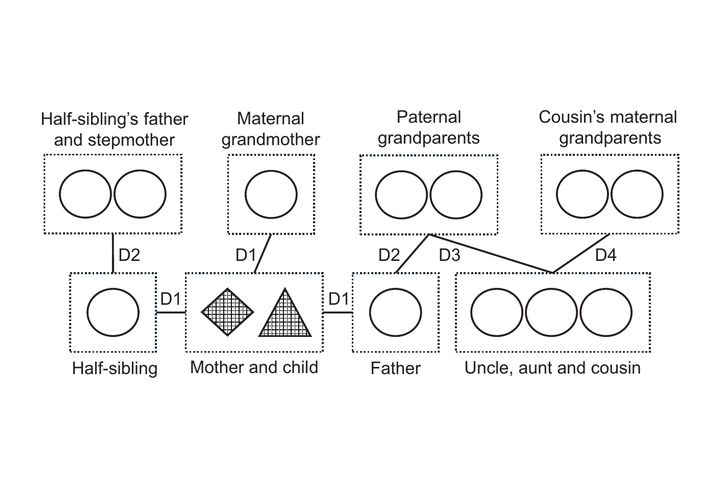 Image credit: Soler, Emery & Kanas, Demography, Fig. 1
Abstract
Families are important sources of social support, yet this support is not available to everyone. Support availability partly depends on the relationships that bind family members into a family structure. Researchers increasingly analyze such relational structures through a network rather than a household perspective. We identify two issues with this approach: insufficient attention to the importance of coresidence for support availability and an assumption that family networks do not overlap. We tackle these issues by conceptualizing families as networks of households interconnected at a population scale. Our approach efficiently captures both coresidence patterns and the intergenerational structure of families up to four degrees of separation from a central household. We illustrate the potential of this approach by constructing the ego-networks of 519,187 households with children aged 0–4 using register data from the Netherlands. Through descriptive analysis and linkage to self-reported support outcomes, we unpack heterogeneities in support availability as measured by network composition, size, density, and overlap. Our approach offers a promising framework for studying family structures and processes beyond traditional household and network perspectives.

Tom Emery
Associate Professor
My research interests include family sociology, demography and improving the empirical base of social science research generally.