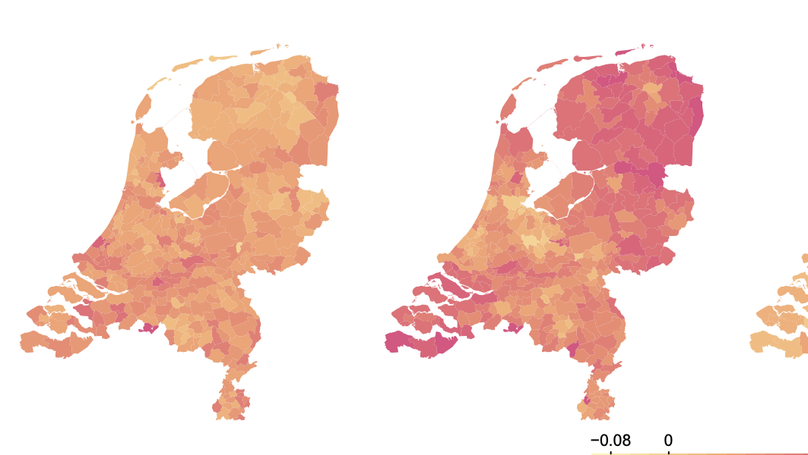
We use the employment records of over 8 million Dutch workers to map how municipalities are connected to one another through the workplace. Applying this to the spread of Omicron, we find that better connected regions saw the wave arrive several days earlier, and that a regional lockdown removes very different amounts of contact depending on where it is imposed.

Having a child reshapes mothers’ employment, but the usual before-and-after comparison hides how bumpy the intervening period is. Following mothers in 20 European countries from ten months before birth to two years after, we find that a third experience genuinely turbulent trajectories, and that the form the turbulence takes differs sharply by education.

Surveys are moving from face-to-face interviews to the web, and we ran an experiment in Germany, Croatia and Portugal to see what that does to the demographic indicators we rely on. The two modes attract different people and produce different answers, and we set out what data users need to do to keep their analyses comparable.

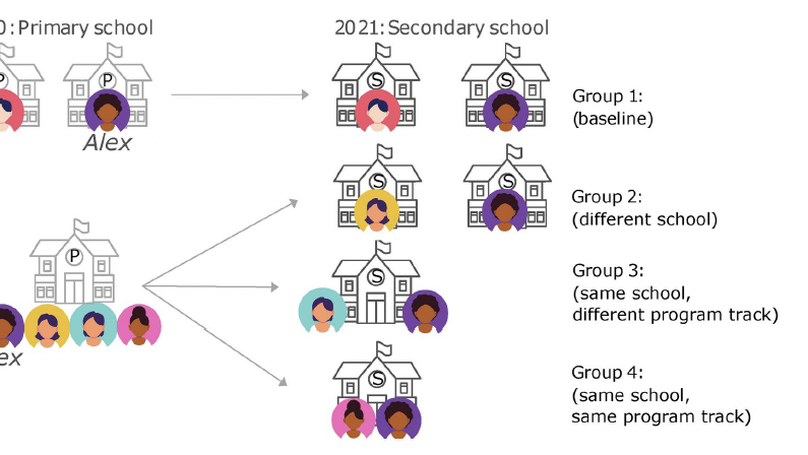
Dutch social care was decentralised to municipalities on the promise that local government could tailor support and lean more on families. Surveying 242 municipalities, we find remarkably little variation in how they actually do this, and no sign that leaning on families has reduced the use of formal care.

Who looks after a first child is usually explained by the parents and grandparents, but families are bigger than that. Using register data on the whole family network and a machine learning approach, we show that great-grandparents, aunts, uncles and cousins add real predictive power — especially for more disadvantaged parents.

We take the population network of the Netherlands and turn it into embeddings — compact numerical summaries of where each person sits in the network — that can be reused across many different prediction problems. The paper sets out how to handle the awkward parts: keeping different kinds of relationship distinct, lining up networks from different years without leaking the future into the past, and splitting the network into balanced pieces.

Higher income parents use more formal childcare, but we know much less about how childcare and work actually fit together month to month. Using Dutch administrative data I trace both across the first four years of a child’s life, and show that lower income households end up with far more fragmented and fragile arrangements — a problem of accessibility and stability, not just cost.

In this paper we set out a new and innovative way of analyzing large scale administrative data through network analysis. We construct a network of the 17 million residents of the Netherlands and link together with their family, colleagues, neighbours and classmates resulting in 1.4 billion links that reveal underlying, structural networks that form the basis of societal interactions.
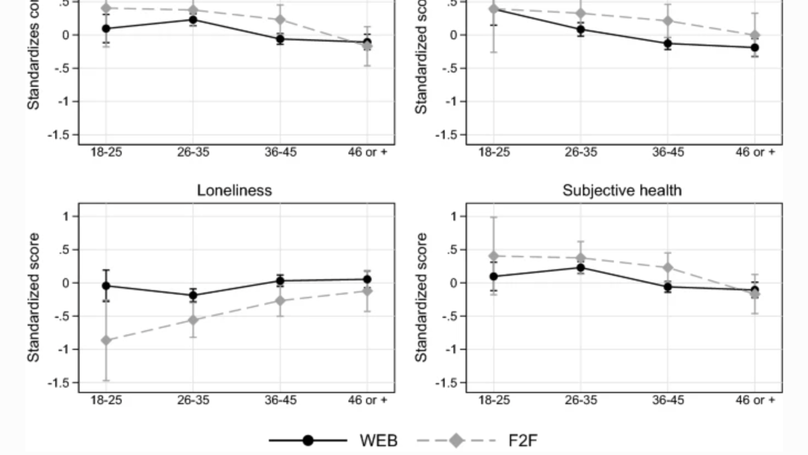
In this paper we use data from the GGP Push to Web experiment to determine whether mode effects can be observed in the association between life satisfaction measures and various objective and subjective socio-economic indicators. Mode effects on point estimates are commonly observed but less is known about mode effects in associations. The results suggest that there is little observable mode effect in the association between variables.

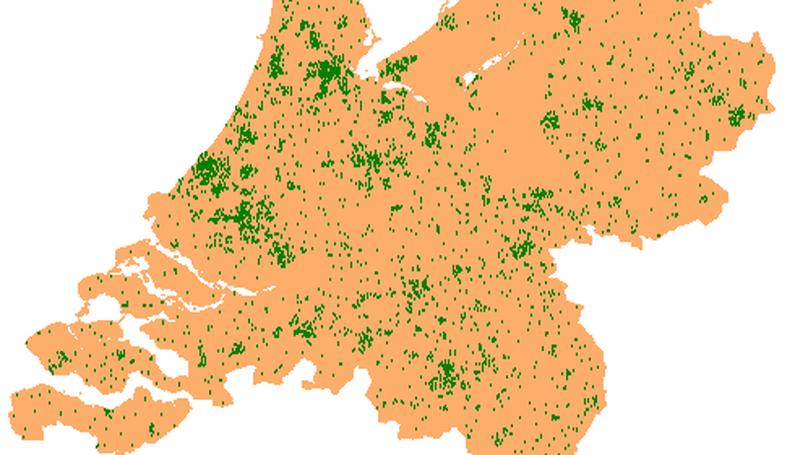
I used geocoded data of respondents to estimate whether the proximity to childcare facilities effected mothers working hours and how this changed over time. The results showed that proximity matters suggesting the density of childcare provision was important in structuring individuals employment choices.

We look at how the experience of being a grandparent differes between China and Europe. Despite grandparents being younger in China, there are many similarities in health, widowhood and employment levels with European grandparents. There are however large differences within China, between urban and rural grandparents.

In this paper we examine how the relationships between parents and children differ across various parts of Chinese society. China has undergone rapid social transformation in the last few decades and there are strong fears that this may have undermined intergenerational solidarity. Our analyses suggest however that these relationships have merely adapted to these changes and we idnetify clear signs of persistent intergenerational solidarity.

Social policies are agorthims which distribute entitlements based an individuals characteristics. In this paper, we set out how these policy algorithms can be formalized and standardized to create powerful tools for policy analysis and provide nuanced insights into the distirbutive mechanics of social policies.

We look at how the experience of being a grandparent differes between China and Europe. Despite grandparents being younger in China, there are many similarities in health, widowhood and employment levels with European grandparents. There are however large differences within China, between urban and rural grandparents.